Basin-Wide Atlantic Ocean Water Mass Classification and Climatic Variability From Machine Learning (JGR MLC, 2026)
Apr 20, 2026· ·
0 min read
·
0 min read
Josh Lanham
Abstract
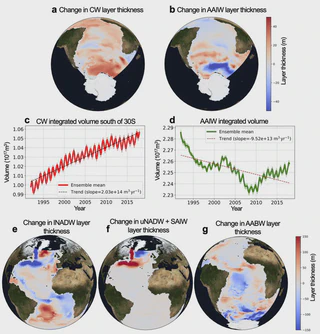
Identification of water masses in the Atlantic Ocean is key to understanding large-scale circulation, transport, and mixing processes. However, traditional classification methods, such as Optimum Multi-Parameter analysis (OMP), are often limited by relatively sparse hydrographic profiles. Here, we develop a hybrid framework, which uses a random forest (RF) modeling approach trained upon an initial OMP analysis that is itself fully constrained by a range of biogeochemical tracers. The resulting model performs robustly even in the absence of such tracers. Given that several observational platforms measure temperature and salinity only, this approach enables the skillful classification of water masses within a much larger expanse of observational data. It also facilitates water mass analysis within large-scale state-estimate products and model output. We apply our RF model ensemble to the Estimating the Circulation and Climate of the Ocean (ECCO) state estimate to produce a gridded Atlantic Ocean water mass product at monthly resolution, which we use to infer changes in Atlantic water mass structure over recent decades. Results indicate a contraction in Antarctic Bottom Water, an expansion of Central Water at the expense of Antarctic Intermediate Water in the Southern Ocean, and a possible poleward shift in Circumpolar Deep Water.
Type
